
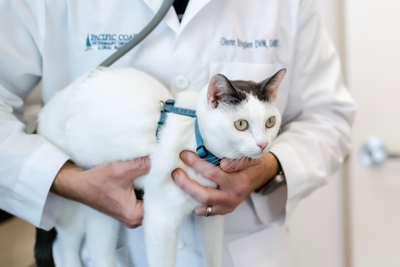
Owners often overlook the teeth and gums of cats because most cats will not allow an oral exam or show an obvious source of pain. Commonly, a change in eating or grooming behaviors or a bad smell from the mouth prompts an owner to bring the cat into their vet. Although a problem may be seen on an oral exam, most feline oral diseases are only found under anesthesia and after performing dental imaging. For this reason, we encourage frequent assessments of your cat’s oral health, to treat current problems and prevent future ones.
Although cats have many similar dental diseases to dogs, there are certain issues that are seen more often in cats, such as tooth resorption and stomatitis. Tooth resorption is defined as the breakdown of the tooth structure by the body’s own cells, called odontoclasts. There are many theories on why this condition develops, but no known exact cause has been identified for this process. Treatment consists of surgical extraction or crown amputation of the affected teeth.
Stomatitis is an autoimmune condition characterized by inflammation of the oral cavity, including the gingiva and the caudal buccal mucosa, or back of the mouth. In the past, it was thought to be caused by a reaction to the bacteria collecting on the teeth but recent studies have shown that this condition is likely multifactorial, meaning multiple conditions can contribute to development of this condition. Recent studies have also implicated a chronic infection by specific virus, called calicivirus, as contributing to the development of the oral inflammation. Their mouth is often red, painful, with halitosis, and many cats are reluctant to eat. Although some oral medications and teeth cleaning can help in the short-term, the most successful known treatment currently is to extract all of the teeth. Although it may seem drastic, most cats feel better and eat well after all the teeth are extracted, and the source of pain is removed from their mouth as the inflammation resolves. A majority of stomatitis cats will have resolution of their inflammation after full mouth extractions but for those who still have inflammation, medical therapy is pursued to provide these patients the best long-term comfort so they can lead a pain-free life. Despite all of this, there are unfortunately some patients whose inflammation never responds to therapy, despite our best efforts.

Cookies on this website are used to both support the function and performance of the site, and also for marketing purposes, including personalizing content and tailoring advertising to your interests. To manage marketing cookies on this website, please select the button that indicates your preferences. More information can be found in our privacy policy here.